
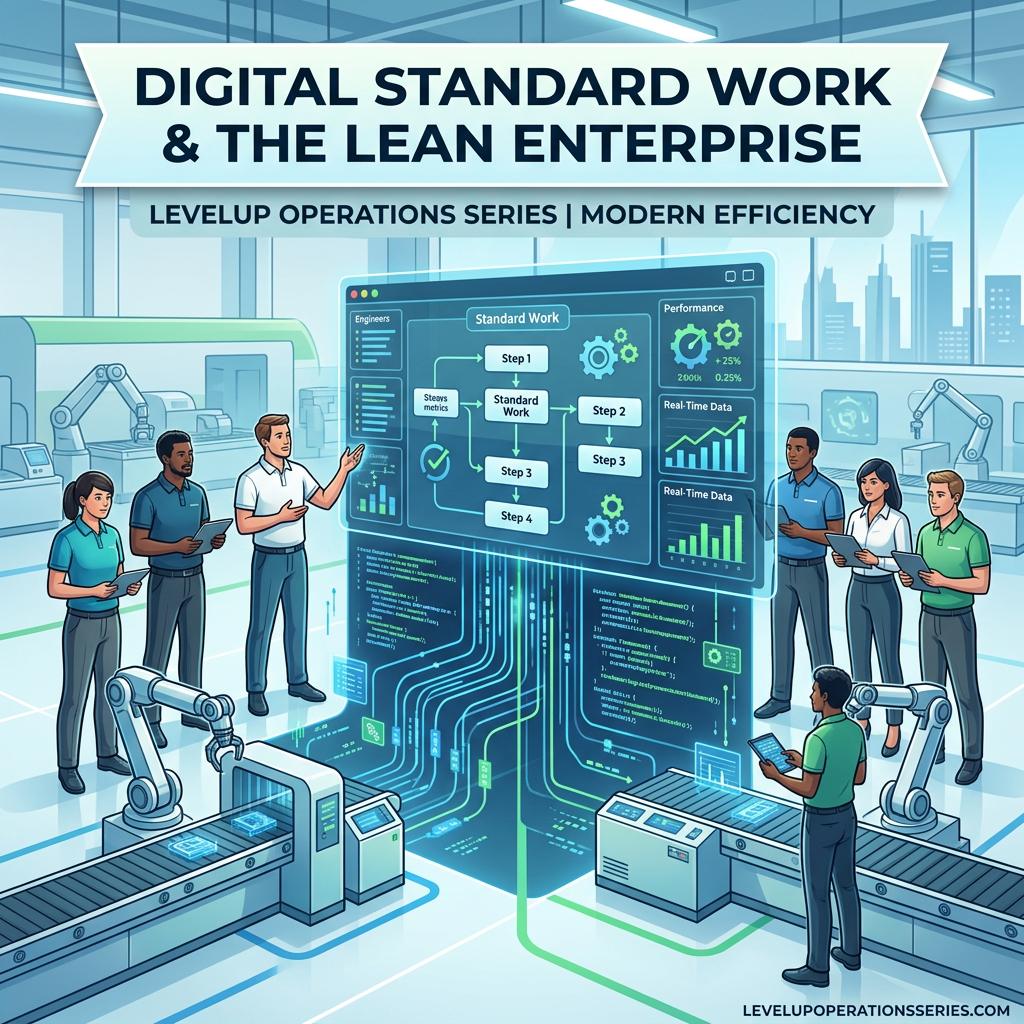
Walk most factories and you will find the same artifact: a binder of standard operating procedures, printed years ago, sitting in a cabinet nobody opens. The work has changed since then. The binder has not. Digital standard work exists to close that gap, but only if you digitize the discipline and not just the documents.
What digital standard work actually is
Digital standard work replaces paper instructions with living documents delivered at the point of use: on a tablet at the station, a screen on the line, or a phone in a technician’s pocket. Done properly it adds what paper never could:
- One current version, everywhere at once, with old revisions retired automatically
- Photos and short video where text used to fail
- Revision history that shows what changed and why
- Feedback loops where operators flag a step that no longer matches reality
- Usage signals that show which standards are consulted and which are ignored
The trap: digitizing a broken standard
A bad procedure on a tablet is still a bad procedure. It is now simply easier to distribute. Before any migration, the standard itself has to be rebuilt with the people who do the work: current best method, key points, reasons for the key points. The technology is the delivery truck, not the cargo.
A rollout sequence that holds up
1. Pick one area with a reason to care
Start where turnover, complexity, or quality pain makes better instructions an obvious win for the crew, not just for the office.
2. Rebuild the standards with the operators
Film the best current method. Break it into steps, key points, and reasons. Keep each standard short enough to be used, not just stored.
3. Put the device where the work happens
If an operator has to walk to a kiosk, the standard will not be consulted. Point of use means point of use.
4. Wire in the feedback loop
The button that says this step is wrong is the most important feature in the system. Every flag should route to the area’s daily management meeting, get an owner, and come back as a revision. This loop is what makes the standard living instead of laminated.
5. Audit usage, then coach
Usage data tells you where standards are ignored. Treat that as information about the standard first and the operator second. A skipped standard is usually a standard that does not match reality.
Where it connects to the lean enterprise
Standard work is the baseline that makes every other lean tool meaningful. You cannot see abnormality without a defined normal, cannot sustain a kaizen without capturing the new method, and cannot train fast without a current standard. Digital delivery strengthens each of those links, provided the underlying discipline of creating, following, and improving standards is being led every day. The technology amplifies the management system. It cannot replace it.
Choosing tools without getting burned
- Favor speed of authoring over feature count. If editing a standard takes an engineer and a workflow, revisions will stop.
- Insist on offline capability on a real shop floor.
- Make sure content exports cleanly. Your standards should outlive any vendor.
- Pilot with one team before signing anything enterprise-wide.
Paper was never the problem. Dead documents were. Digital standard work, built on rebuilt standards and wired into daily management, turns the most neglected lean tool back into what it was always meant to be: the floor’s living memory of its best known way.