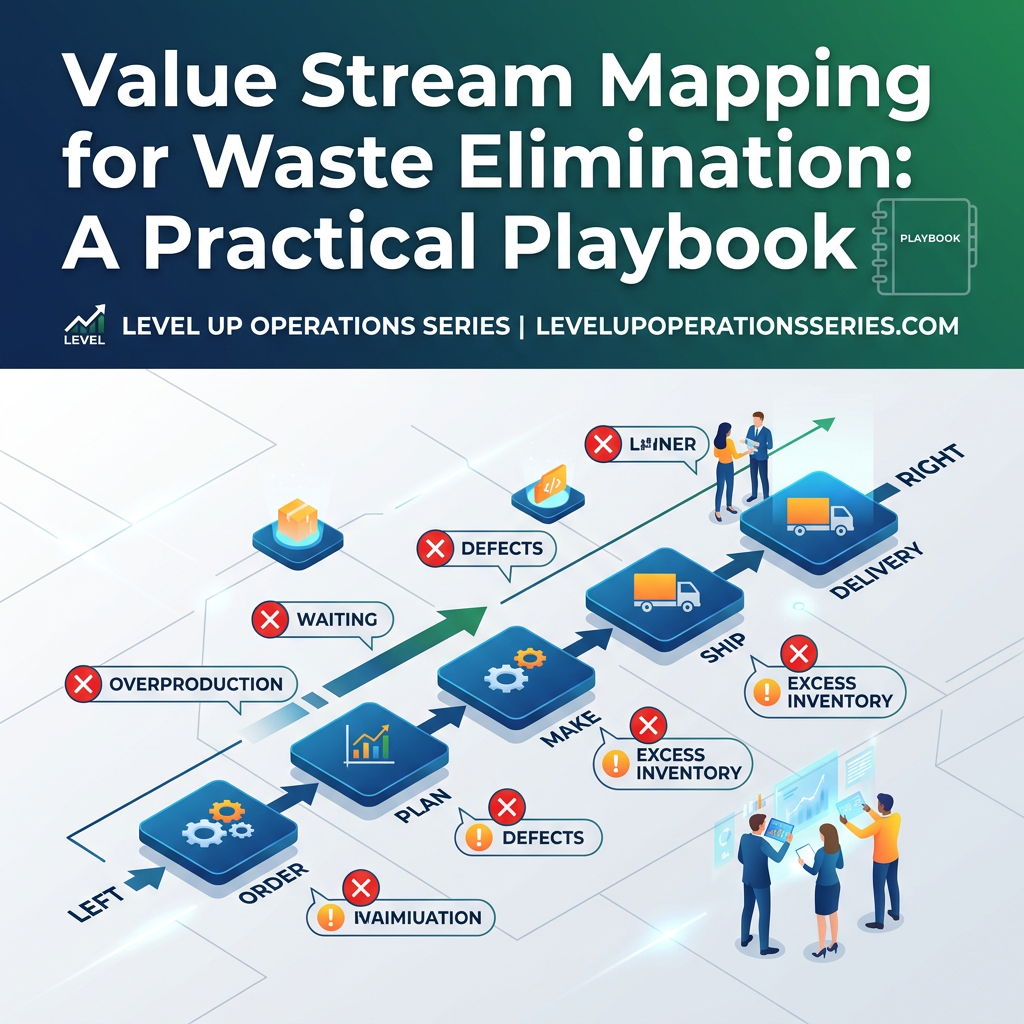
Value stream mapping is the most requested and most misused tool in lean. Teams produce a beautiful current-state map, hang it in a conference room, and change nothing. The map was never the point. The point is the argument the map settles: where the flow actually breaks, and which break to fix first.
Here is a practical playbook for running a value stream map that ends in changed processes instead of laminated wallpaper.
Before the mapping: three decisions
- Scope one product family. Map one representative flow from order to ship. Mapping everything maps nothing.
- Put the right people in the room. The people who touch the flow map the flow: operators, scheduler, materials, quality, maintenance. A map drawn by staff alone will be politely ignored.
- Agree what problem you are solving. Lead time, delivery misses, inventory, overtime. The future state will be shaped by which pain you are chasing.
Walking the current state
Walk the flow in the direction the product travels, at the process, not from memory. At each step capture a small, honest data box: cycle time, changeover, uptime, operators, inventory waiting in front of the step. Then capture the thing most maps skip: the information flow. How does each process know what to run next? Half the waste in most operations lives in that question.
Two rules keep the walk honest:
- Time what you can time; ask the operators about the rest. The scheduler’s system numbers and the floor’s reality often disagree, and the floor is usually right.
- Record what happens on a normal bad day, not the tour-day version.
Reading the map
Add up value-adding time along the bottom of the map and compare it with total lead time. The gap is the opportunity, and in most first maps it is enormous. Then look for the classic break points: the process everyone waits on, the inventory mountains that hide unreliable equipment, the loops where material or paperwork travels backward, and every place the schedule is decided by guesswork.
Designing the future state
A good future-state map answers a handful of questions in order:
- What does the customer actually demand, and what pace does that set?
- Where can processes flow one piece at a time without inventory between them?
- Where flow is impossible today, what small, controlled buffer connects the steps?
- Which single process gets the schedule, so the rest can respond to pull instead of forecasts?
- Which two or three focused improvements would make that design real?
Resist the fantasy future state that requires new equipment and a capital request. The best first future state is achievable in about ninety days with the equipment you already own.
The part that separates results from wallpaper
Translate the future state into a short action plan: each improvement with an owner, a date, and the metric it moves. Then put those actions on the area’s daily management board and review them in the existing cadence, week after week, until the future state is the current state. A map without that rhythm behind it is a drawing. With it, the map becomes the operating plan for the next quarter.
Then, when the future state arrives, map again. The tool is called continuous improvement for a reason.