
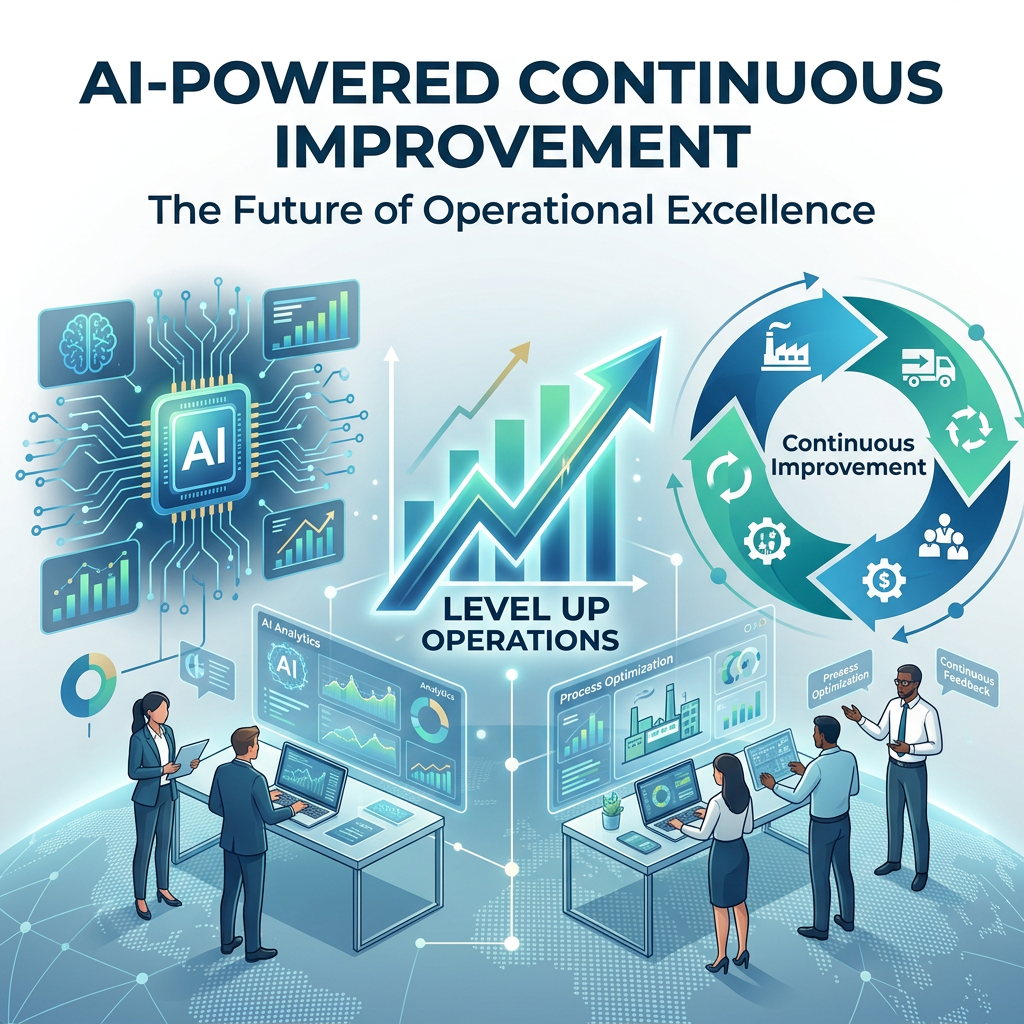
Every few years a technology shows up promising to transform continuous improvement. Most of them end up as another dashboard nobody opens. AI is different in one specific way: it is genuinely good at the part of CI that has always starved for time, which is turning messy operational data into problems worth solving.
This article covers where AI actually helps a continuous improvement system, where it does not, and how to introduce it without turning your operation into a science project.
Where AI genuinely helps CI
Finding patterns humans do not have time to find
Downtime logs, quality escapes, maintenance history, and schedule data hold patterns no supervisor has time to dig out. AI tools are strong at surfacing them: the changeover that always runs long on one crew, the defect that clusters after a specific material lot, the machine whose micro-stops predict a bigger failure. The output is not an answer. It is a better question for your tiered meeting to attack.
Drafting the documents nobody has time to write
Standard work, one-point lessons, training guides, and meeting summaries are the connective tissue of a lean operation, and they are chronically behind. AI can produce a competent first draft of digital standard work from a photo, a transcript, or a bullet list in minutes. The floor still edits and owns the content. The blank page stops being the bottleneck.
Making daily management data honest
When boards are updated by hand at the end of a shift, the numbers drift toward what the shift wishes had happened. Automated collection with AI-assisted summaries gives the morning meeting a cleaner starting point, which changes the conversation from debating the data to solving the problem.
Where AI does not help
- It does not go to the gemba. A model can flag that line three slowed down. It cannot stand at the process and see the operator reaching over a guard because the parts bin moved. Direct observation stays human.
- It does not create ownership. Problems get solved by people who feel responsible for them. No algorithm assigns that feeling.
- It does not fix a broken system. If your operation has no daily management rhythm, AI will simply help you generate reports about problems nobody owns. Install the rhythm first, then accelerate it.
A sane adoption path
1. Start where the data already exists
Do not launch a data-collection project so that AI has something to eat. Start with whatever your machines, ERP, or quality system already logs, and ask one narrow question of it.
2. Pilot on one chronic problem
Pick a recurring loss the floor already cares about and let the tool earn its place by helping close that specific problem. One real win beats a plant-wide platform rollout.
3. Keep humans in the loop where judgment lives
Let AI draft, flag, and summarize. Keep people deciding, coaching, and standardizing. The moment the floor senses the tool is grading them rather than helping them, adoption dies.
4. Fold the output into the existing cadence
AI findings should land in the same tiered meetings and improvement backlog as every other problem. A separate AI dashboard with its own meeting is a parallel bureaucracy in the making.
The bottom line
AI is a genuine accelerant for continuous improvement, and it is only an accelerant. Poured onto a working daily management system, it compounds the gains. Poured onto chaos, it produces faster, better-formatted chaos. Build the rhythm, then add the horsepower.